Introduction
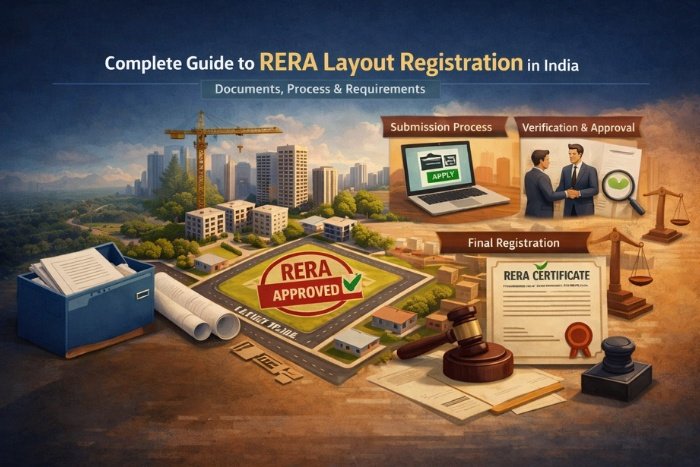
RERA layout registration in India came into force under the Real Estate (Regulation and Development) Act, 2016. Its primary objective is to bring transparency, accountability, and discipline to the real estate sector. Through this framework, the Real Estate Regulatory Authority (RERA) protects homebuyers and ensures that developers, agents, and real estate projects follow a uniform system of compliance with accurate and timely disclosure of information.
RERA and Its Purpose
The Real Estate Regulatory Authority (RERA) was established in India under the Real Estate (Regulation and Development) Act, 2016, to bring transparency, accountability, and discipline to the real estate sector. Through this regulatory framework, the interests of homebuyers are safeguarded while developers, agents, and real estate projects are brought under a uniform system of compliance. The real estate market, which was once largely unregulated, is now monitored to ensure fair practices, timely project delivery, and accurate disclosure of information.
RERA Registration Requirements and Applicability
Under RERA, real estate projects are required to be registered before any form of advertising, marketing, or sale is undertaken. This registration becomes mandatory when a project exceeds 500 square meters of land area or involves more than 8 residential units, making RERA applicable to most medium and large-scale developments. By enforcing project registration, fund utilization through escrow accounts, standardized carpet area definitions, and strict timelines, greater trust and confidence are created among buyers.
How RERA Has Improved Transparency and Buyer Protection
Overall, RERA plays a crucial role in regulating the entire real estate ecosystem by overseeing project approvals, developer obligations, agent conduct, and buyer rights. Its implementation has helped transform the Indian real estate sector into a more organized, transparent, and buyer-friendly market, making property investment and ownership safer and more reliable.
Documents Required for RERA Layout Approval in India
RERA approval is not just an online form submission but RERA registration is a regulated process where authorities carefully verify land ownership, planning approval, and on-ground site conditions.
1. Site Images – Drone & Normal Geo-Tagged Photos
RERA authorities needs site images taken by drone for ariel view of the layout and normal geo-tagged photos to confirm that the land existence and developments on the ground.
Geo-tagging ensures the photos are taken at the actual site location.
Why it is needed:
- Confirms Site boundaries and access roads
- Confirms the Newly Formed Layout Roads with approved drawings
- Prevents false or misleading applications
2. IT Copy (Income Tax Return)
RERA focuses on financial transparency.
Why it is required:
- Confirms the applicant’s financial identity
- Ensures accountability to buyers
- Bulit’s confidence on buyers about seller
3. Current Document (Title Deed)
This proves who legally owns the land today.
Common examples:
- Sale Deed
- Gift Deed
- Settlement Deed
- Partition Deed
Without a valid title document, layout approval cannot proceed.
4. Planning Authority & Local Body Approvals
RERA only accepts layouts that have already been approved by the relevant planning and local authorities. These approvals work together to ensure complete compliance.
- Planning Authority Approval (DTCP / Urban Development Authorities / Local Planning Authority)
- Confirms the land is legally designated for residential/commercial use
- Ensures roads, plots, and open spaces meet regulatory standards
- Validates that the layout design follows approved development plans
- Prevents illegal or unauthorized layouts from being marketed
- Local Body Approval (Panchayat / Municipal Corporation)
- Confirms compliance with local development rules and bylaws
- Ensures the project aligns with grassroots-level regulations
- Verifies local infrastructure and amenity requirements are met
Why Both Matter:
These approvals establish the legal foundation of any layout. RERA does not replace or bypass planning approval—it verifies that proper approvals are already in place before allowing a project to be registered.
5. Encumbrance Certificate (EC)
EC shows the legal history of the land.
Why it is checked:
- Confirms the land is free from loans or disputes
- Ensures clear ownership chain
- Protects future buyers
6. Patta / Land Ownership Record
Patta or Land Ownership Record confirms the land is recorded in government revenue records.
Why this is important:
- Confirms ownership with survey details
- Verifies land Extent and Type
- Avoids future disputes
7.Aadhaar Card
8. PAN Card
9. Owner / Promoter Photograph
Before giving approval, authorities carefully review the application in a very practical way. They first confirm who legally owns the property by checking ownership papers, EC, and Patta. Next, they ensure the project follows planning rules, with proper approvals from the planning authority and local body.
Finally, they verify the actual site and the applicant’s identity through geo-tagged photos, Aadhaar, PAN, and IT returns. Only when everything matches on paper and on ground is the approval granted.
How to Apply for RERA Layout Registration in India
After preparing all required documents, the next question most landowners and promoters ask is:
“How do I actually apply for RERA layout approval?”
Although the portal design may vary slightly from state to state, the RERA registration process follows a standard structure across India.
Below is a clear step-by-step explanation.
Step 1: Visit the State RERA Official Website
Each state has its own RERA portal
(Example: Tamil Nadu RERA, Karnataka RERA, Maha RERA, etc.)
On the portal:
- Select “New Registration”
- Choose Layout / Plotted Development Project
- Create promoter login using:
- Email ID
- Mobile number
- PAN & Aadhaar
Step 2: Fill in Project & Promoter Details
You will be required to enter:
Promoter Details
- Name (individual / firm / company)
- Address and contact details
- PAN, Aadhaar, IT details
Project Details
- Layout name
- Location & survey numbers
- Total land extent
- Number of plots
- Development status
Accuracy is critical—any mismatch leads to objections.
Step 3: Upload Required Documents
Upload scanned copies of:
- Title deed
- Planning approval & drawings
- EC
- Patta / revenue records
- Aadhaar & PAN
- IT returns
- Geo-tagged site photos
- Promoter photograph
Note:
All files must be Clear, Readable, In accepted file formats and size limits
Step 4: Pay RERA Registration Fee Online
RERA registration fee varies by state and project size.
Payment is made online through:
- Net banking
- Debit / credit card
- Government payment gateway
After payment, an RERA application number is generated. Then RERA officials thoroughly scrutinizes the application—checking legal ownership, planning approvals, site details, and the promoter’s identity and financial transparency. Any discrepancies must be clarified promptly. Once all checks are successfully completed, RERA issues the official approval order, after which the layout can be legally advertised, marketed, or sold.
Many RERA applications face delays or rejections due to common mistakes such as missing planning approvals, incorrect survey numbers, non–geo-tagged site photos, mismatched names between PAN, Aadhaar, and title deeds, outdated or incomplete Encumbrance Certificates, or unclear documents. To avoid these issues, it’s important to verify all documents carefully before submission.
Final Conclusion
RERA layout registration in India goes beyond regulatory approval. It builds trust, transparency, and long-term buyer protection.
When a project is registered under RERA, buyers gain confidence in its legal validity and transparency. At the same time, promoters enhance their credibility and long-term reputation. Ultimately, RERA ensures that property investment remains safe, genuine, and secure for everyone involved.