Introduction
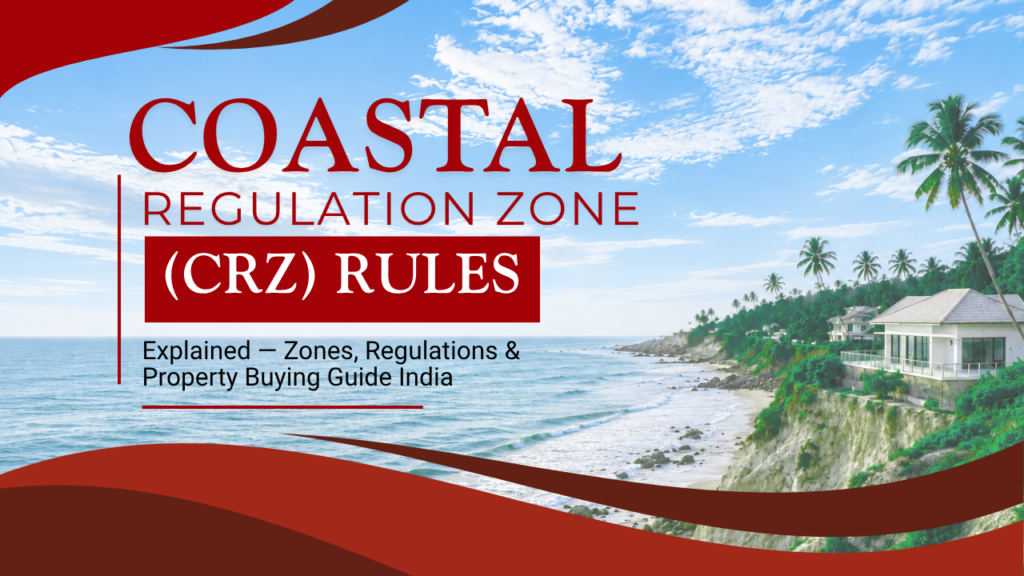
CRZ Rules in India regulate construction and development activities in Coastal Regulation Zone areas. If you are planning to buy land, build a home, develop a commercial property, or invest in coastal property in Tamil Nadu or anywhere in India, understanding these regulations is essential.
These regulations determine where development is permitted, what activities are allowed, what restrictions apply, and which authority is responsible for the applicable clearance.
The primary framework is the CRZ Notification, 2019, which was issued to conserve and protect coastal stretches and marine areas while also supporting sustainable development and the livelihood of coastal communities.
The 2019 framework was subsequently amended through:
- S.O. 4886(E) dated 26.11.2021
- S.O. 5495(E) dated 24.11.2022
These amendments introduced and substituted specific provisions in the 2019 notification.
What Is CRZ?
Understanding CRZ Rules in India helps property buyers and developers identify applicable coastal restrictions before purchasing land or starting construction.
The Coastal Regulation Zone (CRZ) is a legally regulated coastal area where development activities are controlled to protect coastal and marine environments.
The CRZ framework uses features such as:
- High Tide Line (HTL)
- Low Tide Line (LTL)
- Tidal influence
- Ecologically sensitive areas
- Existing development
- Coastal Zone Management Plans (CZMPs)
The CRZ generally covers the land area from the HTL up to 500 metres on the landward side along the sea front, along with specified tidal water bodies and coastal water areas covered under the notification.
Why CRZ Rules Can Make or Break Your Investment
Coastal areas are environmentally sensitive and can also be vulnerable to:
- Coastal erosion
- Flooding
- Cyclones
- Sea-level rise
- Saltwater intrusion
- Damage to coastal ecosystems
The CRZ framework therefore aims to balance environmental protection, coastal development and the livelihood needs of coastal communities.
For property buyers, this means that being close to the sea does not automatically mean that the land is suitable for construction.
The CRZ classification, HTL, applicable CZMP and permitted activities should be checked before purchasing or developing coastal property.
The Four Types of Coastal Regulation Zones
Under the CRZ Notification, coastal areas are broadly classified into:
- CRZ-I – Ecologically Sensitive Areas
- CRZ-II – Developed Coastal Areas
- CRZ-III – Relatively Undisturbed Areas
- CRZ-IV – Water Areas
CRZ-III is further divided into CRZ-IIIA and CRZ-IIIB, while CRZ-IV is divided into CRZ-IVA and CRZ-IVB.
CRZ-I — Ecologically Sensitive Areas
CRZ-I consists of environmentally sensitive areas and important coastal geomorphological features.
These include:
- Mangroves
- Corals and coral reefs
- Sand dunes
- Biologically active mudflats
- National parks
- Marine parks
- Sanctuaries
- Wildlife habitats
- Biosphere reserves
- Salt marshes
- Turtle nesting grounds
- Horseshoe crab habitats
- Seagrass beds
- Bird nesting grounds
- Archaeological and heritage sites
Construction Rules
CRZ-I areas are highly restricted.
Generally, no activities are permitted in CRZ-IA except for specifically permitted activities such as certain eco-tourism activities, public utilities in mangrove buffers, and exceptional defence, strategic or public utility projects subject to the required safeguards and approvals.
Investment Insight
Private development opportunities in CRZ-I can be highly restricted. Therefore, buyers should verify the CRZ classification and permitted activity before considering such land for investment.
CRZ-II — Developed Coastal Areas
CRZ-II covers developed coastal areas within existing municipal limits or other legally designated urban areas that are substantially built-up.
The notification identifies CRZ-II areas based on factors such as:
- Existing built-up development
- Roads
- Drainage
- Water supply
- Sewerage
- Other infrastructure
The notification specifies that substantially built-up areas have a ratio of built-up plots to total plots of more than 50%.
Construction Rules in CRZ-II
Construction of buildings for:
- Residential purposes
- Schools
- Hospitals
- Institutions
- Offices
- Public places
is permitted only on the landward side of an existing road or on the landward side of existing authorised fixed structures, subject to the applicable conditions.
A new road constructed on the seaward side of an existing road does not create a basis for permitting construction on its landward side under the specified restriction.
FSI / FAR Rule in CRZ-II
Buildings permitted under CRZ-II are subject to:
- Local town and country planning regulations
- The FSI/FAR norms prevailing as on the date of the CRZ Notification, 2019
If a change in FSI is required after the notification, the prescribed process involving the concerned planning authority, State/UT CZMA and National Coastal Zone Management Authority applies.
The CRZ 2019 notification refers to the FSI/FAR prevailing as on the date of the notification.
FSI is determined by the applicable State/local planning regulations and may vary based on location, plot size, road width, and building type.
Height & Density Restrictions in CRZ-II
The permissible building height and size are determined by the concerned local authority, in accordance with applicable development regulations.
Permitted Development in CRZ-II
Subject to applicable CRZ and local planning regulations, the following developments may be permitted:
- Residential Buildings – Houses, apartments and other permitted residential uses.
- Schools & Educational Institutions – Educational buildings subject to applicable planning requirements.
- Hospitals – Healthcare facilities with the required approvals.
- Offices & Institutions – Permitted commercial and institutional buildings.
- Public Buildings – Buildings intended for permitted public uses.
- Reconstruction – Reconstruction of authorised existing buildings, subject to applicable FSI/FAR and planning rules.
- Hotels & Beach Resorts – Designated tourism developments where specifically permitted.
- Temporary Tourism Facilities – Permitted temporary facilities subject to CRZ conditions.
How to Develop in CRZ-II?
Before starting the project, check:
CRZ-II status → Permitted land use → Existing authorised road/structure → Applicable FSI/FAR → Local planning rules → Required approvals
The proposed development should satisfy both CRZ requirements and local development regulations before construction begins.
Important
CRZ-II does not mean that the entire plot is automatically available for construction. Development feasibility must be checked based on the specific property’s CRZ status, location, permitted use and applicable regulations.
CRZ-III — Relatively Undisturbed Coastal Areas
CRZ-III covers relatively undisturbed areas, including rural areas, that do not fall under CRZ-II.
CRZ-III is divided into:
- CRZ-IIIA
- CRZ-IIIB
The applicable NDZ depends on the category and the status of the approved CZMP.
CRZ-IIIA — Densely Populated Areas
CRZ-IIIA covers densely populated CRZ-III areas where the population density is more than 2161 persons per square kilometre, based on the 2011 Census.
No Development Zone
In CRZ-IIIA:
50 metres from the HTL on the landward side is designated as the NDZ where the CZMP prepared under the CRZ 2019 framework has been approved.
If the required CZMP has not been approved, the 200-metre NDZ continues to apply.
CRZ-IIIB — Other CRZ-III Areas
CRZ-IIIB covers other CRZ-III areas where the population density is less than 2161 persons per square kilometre, based on the 2011 Census.
In CRZ-IIIB:
200 metres from the HTL on the landward side is designated as the NDZ.
Important Correction
Therefore, the statement:
“CRZ-III has a 0–200 metre NDZ”
is not accurate for every CRZ-III area.
The correct classification is:
- CRZ-IIIA → 50 m NDZ where the approved CZMP applies; otherwise 200 m
- CRZ-IIIB → 200 m NDZ
What Can Be Developed in CRZ-III?
Within the NDZ, construction is generally restricted.
However, the notification permits or regulates specific activities, including:
- Repair/reconstruction of existing authorised structures
- Permitted activities under the notification
- Dwelling units of traditional coastal communities
- Agriculture
- Horticulture
- Gardens
- Pastures
- Parks
- Playfields
- Forestry
- Certain local public facilities
- Facilities required for local fishing communities
- Certain temporary tourism facilities
Beyond the NDZ, permitted activities include designated tourism projects, construction/reconstruction of dwelling units within traditional rights and customary uses, home-stay facilities for local communities and specified public infrastructure.
Height & Density Restrictions in CRZ-III
A specific 9-metre height and Ground + 1 floor condition applies to the construction or reconstruction of dwelling units within the traditional rights and customary uses of existing fishing villages and similar traditional coastal communities, subject to local planning rules.
The notification specifies:
- Maximum height: 9 metres
- Maximum floors: Ground + 1
CRZ-IV — Water Areas
CRZ-IV covers coastal water areas and is divided into:
- CRZ-IVA – sea and seabed area between the LTL and 12 nautical miles on the seaward side
- CRZ-IVB – water and bed areas of tidal-influenced water bodies within the specified tidal influence
Permitted Activities
Activities regulated under CRZ-IV include:
- Traditional fishing
- Allied activities by local communities
- Ports and harbours
- Jetties
- Slipways
- Erosion-control measures
- Waterway maintenance
- Tidal regulators
- Storm-water drains
- Salinity-intrusion prevention measures
- Offshore renewable-energy facilities
- Certain strategic and defence projects
- Oil and natural gas exploration/extraction
- Pipelines
- Weather radar and ocean observation platforms
Important Amendments to CRZ 2019
The CRZ 2019 Notification was later amended by:
- S.O. 4886(E) — 26 November 2021
- S.O. 5495(E) — 24 November 2022
The consolidated notification identifies which provisions were inserted and which were substituted through these amendments.
2021 Amendment — S.O. 4886(E)
The 2021 amendment introduced specific provisions relating to HTL determination, the Sundarbans Biosphere Reserve and dead-shell collection.
1. HTL in Areas with Old Bunds or Sluice Gates — Substituted
Where a bund or sluice gate constructed before 19 February 1991 exists, the HTL is restricted to the line along the bund or sluice gate.
However, mangrove areas that arise because of saline-water ingress beyond the bund or sluice gate are classified as CRZ-IA, irrespective of their extent, and are protected from diversion for development.
Why was this changed?
This provision clarifies how the HTL is determined in areas where old bunds or sluice gates exist and provides specific protection to mangroves arising beyond them.
2. Sundarbans Biosphere Reserve — Inserted
Sundarbans Biosphere Reserve — Inserted
A specific provision was inserted for the Sundarbans Biosphere Reserve.
For the Sundarbans Biosphere Reserve:
- CRZ categorisation
- HTL delineation
- CRZ boundary delineation
are to be dealt with in accordance with the CRZ notification.
The Critical Vulnerable Coastal Area (CVCA) within the Sundarbans Biosphere Reserve is to be managed through an Integrated Management Plan prepared by the State Government and approved by the Central Government.
3. Collection of Dead Shells — Inserted
A provision was inserted allowing traditional communities to collect dead shells for poultry and animal-feed supplements.
Such collection does not require prior CRZ clearance under the inserted provision.
2022 Amendment — S.O. 5495(E)
The 2022 amendment made several changes to the CRZ framework, including provisions relating to temporary structures, clearance authority, CRZ maps, the clearance process, Integrated Island Management Plans and sand-bar removal. The consolidated notification marks the relevant provisions as either substituted or inserted.
1. Temporary and Seasonal Beach Structures — Inserted
The amendment inserted a provision for purely temporary and seasonal structures, such as shacks customarily put up during the non-monsoon months.
The facilities in these structures must remain non-operational during the monsoon months.
2. CRZ Clearance Authority
CRZ clearance depends on the CRZ category and the type of project.
For development activities or projects in CRZ-I and CRZ-IV, the Central Government generally handles CRZ clearance based on the recommendation of the concerned CZMA.
However, the following specific activities are dealt with by the concerned Coastal Zone Management Authority:
- Stand-alone jetties
- Salt works
- Slipways
- Temporary structures
- Erosion-control measures, such as:
- Bunds
- Seawalls
- Groynes
- Breakwaters
- Submerged reefs
- Sand nourishment
For projects located purely in CRZ-II and CRZ-III, the concerned CZMA considers the CRZ clearance. If such a project also traverses CRZ-I or CRZ-IV, the clearance is considered by the Ministry of Environment, Forest and Climate Change based on CZMA recommendations.
Category A and Category B Projects
Some projects may attract both the CRZ Notification and the EIA Notification.
In such cases, a composite Environmental and CRZ Clearance is processed under the applicable EIA framework.
Category A Projects
Category A projects include projects such as:
- Major infrastructure projects
- Large industries
- Ports and harbours
- Large mining projects
- Major power projects
For applicable Category A projects, the composite Environmental and CRZ clearance is handled at the Central Government level.
Category B Projects
Category B projects are projects that fall under the applicable Category B criteria under the EIA framework.
For applicable Category B projects, the composite clearance is handled at the State level through SEIAA.
The notification specifically provides for SEIAA and the Ministry of Environment, Forest and Climate Change for Category B and Category A projects respectively.
NOTE: CRZ Zones and Category A/B Are Different
Do not confuse:
CRZ-I / II / III / IV
→ Classification of the coastal area
Category A / B
→ Classification of the project for Environmental Clearance
A project can therefore have both a CRZ classification and an applicable EIA category.
3.CRZ Map Requirements — Substituted
The CRZ clearance application requires a CRZ map at 1:4000 scale prepared using the applicable:
- HTL
- LTL
- Ecologically sensitive areas
The project layout must also be superimposed on the CRZ map, showing:
- Project boundaries
- CRZ category
- Applicable location details
The notification also requires the CRZ map to normally cover a 7-kilometre radius around the project site, showing CRZ-I, II, III and IV areas and other notified ecologically sensitive areas.
4.CRZ Clearance Procedure
Project proponents must submit the required documents to the concerned State/UT Coastal Zone Management Authority for prior clearance.
Depending on the project, documents can include:
- Project summary
- EIA reports, where applicable
- Risk Assessment Report
- Disaster Management Plan
- CRZ map
- Project layout
- CRZ classification
- Applicable Pollution Control Board consent/NOC
5.60-Day Consideration Period
The concerned Coastal Zone Management Authority is required to examine the complete application and make its recommendations within 60 days from the date of receipt of the complete application.
For projects covered under the EIA Notification, CZMA recommendations are forwarded to the appropriate authority for Category A or Category B projects.
For certain projects not covered under the EIA Notification but falling under CRZ-II, CRZ-III or the specified exception category, the concerned CZMA considers the clearance within the prescribed 60-day period.
NOTE: Important
60 days does not mean automatic CRZ approval. It is the prescribed period for consideration/recommendation of a complete proposal.
6.Building and Construction Projects
For building or construction projects with built-up area below the threshold prescribed under the EIA Notification, approval is handled by the concerned State or UT Planning Authority, after obtaining recommendations from the concerned CZMA.
For self-dwelling units up to a total built-up area of 300 square metres, approval can be given by the concerned local authority without requiring recommendations from the CZMA, although the authority must examine the proposal from the CRZ perspective.
7.Integrated Island Management Plans
The notification also contains provisions relating to Integrated Island Management Plans (IIMPs) for applicable islands.
The amended provision requires such plans to be formulated by the respective State Governments or UT Administration for applicable islands and submitted to the Central Government.
Until the applicable plans are framed, the notification specifies the regulatory arrangement to be followed.
8.Removal of Sand Bars — Inserted
A specific provision was inserted for the removal of sand bars in CRZ areas.
Sand bars in intertidal areas may be removed by traditional coastal communities using non-mechanised manual methods.
The State Government or UT Administration may permit such removal for a specified:
- Time period
- Area
- Quantity
subject to conditions including registration of local community persons permitted to remove the sand manually, with renewal on a yearly basis.
Quick Decision Guide for Buyers & Developers
| CRZ Category | Basic Regulation | Investment Consideration |
| CRZ-I | Ecologically sensitive; development highly restricted | Very Low |
| CRZ-II | Developed coastal area; construction subject to specified conditions | Relatively Better |
| CRZ-IIIA | 50 m NDZ where approved CZMP applies; otherwise 200 m | Location-specific |
| CRZ-IIIB | 200 m NDZ from HTL | Restricted |
| CRZ-IV | Water areas; activities regulated | Project-specific |
Common Buyer Mistakes in CRZ Land Purchase
1. Buying land without checking CRZ classification
Not every coastal property is equally suitable for development.
2. Assuming all coastal land is buildable
CRZ restrictions depend on the specific category and applicable provisions.
3. Ignoring HTL
The distance from the HTL can directly affect the applicable NDZ and development restrictions.
4. Ignoring the approved CZMP
For CRZ-IIIA in particular, the applicable NDZ depends on whether the CZMP under the 2019 framework has been approved.
5. Assuming “outside NDZ” means “anything can be built”
Development outside the NDZ is still subject to the activities specifically permitted under the notification.
6. Assuming 60 days means automatic approval
The 60-day period relates to consideration/recommendation of a complete application. It does not mean automatic approval.
7. Assuming one authority handles every CRZ project
The clearance authority depends on the CRZ category and project type.
Conclusion
The CRZ Notification 2019 provides the basic regulatory framework for development along India’s coastal areas. The subsequent amendments through S.O. 4886(E) dated 26.11.2021 and S.O. 5495(E) dated 24.11.2022 introduced and substituted specific provisions relating to HTL determination, sensitive coastal areas, temporary structures, clearance procedures, CRZ mapping, island management and sand-bar removal.
For property owners, builders, architects and investors, CRZ due diligence should include checking:
- CRZ classification
- HTL and LTL
- Applicable NDZ
- Approved CZMP
- Permitted activity
- Applicable clearance authority
- EIA Category A/B applicability
- Required CRZ and environmental clearances
A proper CRZ verification before purchasing land or beginning construction can help avoid regulatory complications and financial risks later.
Key Regulatory Terminology
CRZ – Coastal Regulation Zone
HTL – High Tide Line
LTL – Low Tide Line
NDZ – No Development Zone
FSI – Floor Space Index
FAR – Floor Area Ratio
CZMA – Coastal Zone Management Authority
SCZMA – State Coastal Zone Management Authority
NCSCM – National Centre for Sustainable Coastal Management
EIA – Environmental Impact Assessment
SEIAA – State Environment Impact Assessment Authority
CZMP – Coastal Zone Management Plan
IIMP – Integrated Island Management Plan
CVCA – Critically Vulnerable Coastal Area