INTRODUCTION
Buying or owning property involves more than just a sale deed. In Tamil Nadu, several land records and approvals play an important role in verifying ownership, checking legal status, and ensuring a property is safe for purchase or development. However, many property owners and buyers are not fully aware of these essential terms and documents.
From Patta and FMB to Encumbrance Certificate and DTCP approval, each record serves a specific purpose in establishing clarity and avoiding legal complications. Understanding these common land record terms not only helps in making informed decisions but also protects you from future disputes and financial risks.
This guide explains the most important land-related documents every property owner must know, in a simple and practical way.
1. PATTA
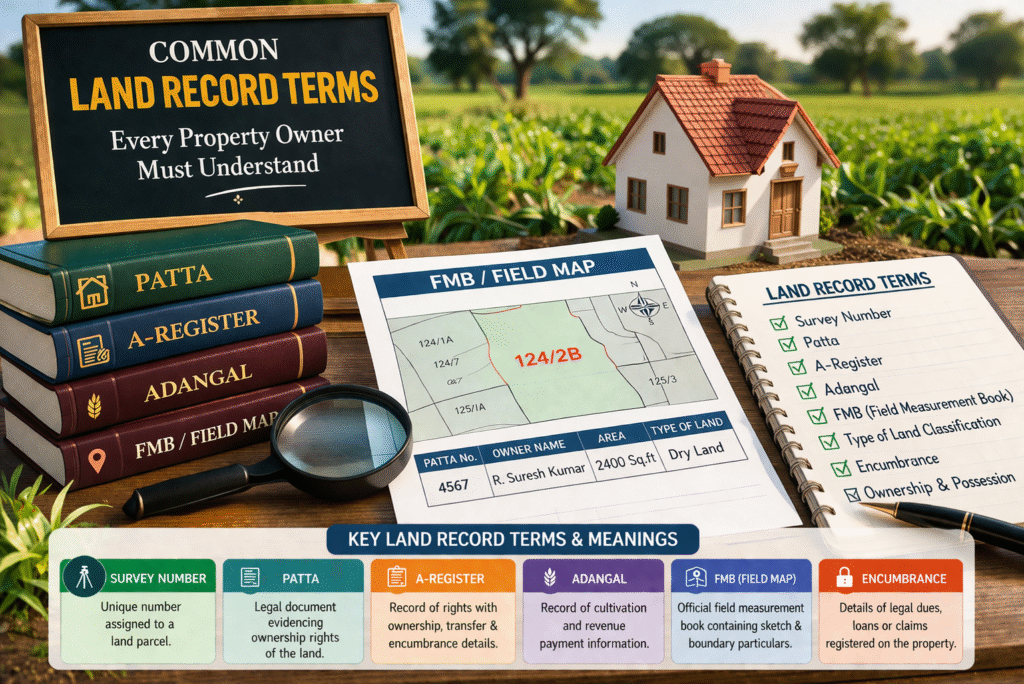
Patta is a government-issued document that proves ownership of land. It is primarily used to classify land types (e.g., Natham, wet or dry land), verify land ownership, determine land extent, and assess taxes. You can easily view your Patta online at eservices.gov.in. If your Patta does not show your name, you must apply for a Patta transfer to update ownership. If the land extent in the Patta does not match the actual extent, you should apply for land subdivision so that government records officially recognize you as the rightful owner of the entire property.
2. FMB
FMB (Field Measurement Book) is the official land sketch issued by the government. It contains a detailed map with measurements of all sides of a property, clearly showing its exact shape, size, and boundaries. It is mainly used to identify the correct position and extent of the land. To obtain an FMB, you can visit the online land records portal. For example, if two neighbouring landowners are unsure about the boundary between their plots, the FMB sketch can be used to clearly identify the correct boundary and avoid disputes.
3.A– REGISTER
The A-Register is one of the most fundamental land records maintained by the revenue department. It includes key information such as the owner’s name, survey number, land classification, and total extent. In many cases, this document serves as the first point of reference when verifying land ownership. Access is simple—either through the Tamil Nadu land records portal or directly from the VAO or Taluk office. It becomes especially useful when a quick ownership check or land classification confirmation is required.
4. TSLR
TSLR is nothing but a Patta but for properties located in urban areas, the Town Survey Land Register (TSLR) plays a crucial role. It records details like the owner’s name, town survey number, subdivision, and land extent. Unlike rural records, TSLR is specifically designed for city-based properties, making it an essential document for urban land verification. Property owners can review it online or obtain it through municipal or Taluk offices to ensure all details are properly recorded.
5. TSLR SKETCH
TSLR Sketch is nothing but an FMB in Urban areas, it offers a visual representation of the property. It clearly outlines the shape, size, and exact boundaries of a plot within urban limits. This makes it highly valuable when understanding property layout or resolving boundary-related concerns. The sketch can be accessed online or collected from the concerned local authority.
6.RSR (RE-SURVEY REGISTER)
Land records are not always static; they have been updated over time. This is where the Resurvey Register (RSR) becomes important. It contains older ledger details such as property ownership records, government land details, and measurements.
Whenever discrepancies arise, it is necessary to compare current updated records with these older RSR records. The RSR serves as a reliable reference to verify and validate land information.
7. ADANGAL
At the village level, Adangal provides a deeper insight into how land is actually being used. It records not just ownership details, but also cultivation patterns, crop types, and land usage. This makes it particularly important for agricultural properties. Available through the VAO office and sometimes online, Adangal helps in understanding the practical use of land beyond just ownership.
8. LEGAL OPINION
Before finalizing any property transaction, a legal opinion adds an extra layer of security. A qualified lawyer reviews all relevant documents—such as sale deeds, Patta, and EC—to identify any legal risks, disputes, or liabilities. This step is often considered essential, as it provides clarity on whether the property is truly safe for investment.
9. LAND SURVEY
Accurate boundary identification is crucial in land ownership, and this is achieved through a proper land survey. Using official measurement methods, the exact dimensions and limits of a property is surveyed and verified with revenue documents like FMB and Patta. This process is particularly helpful in resolving boundary disputes or confirming land extent before construction or purchase.
10. HACA CLEARANCES
At the regional level, Lands under HACA () limits needs special Clearances. HACA plays a crucial role in regulating and protecting development in hill areas. It ensures that any construction or land use in notified hill regions follows environmental guidelines and safety norms. HACA approval verifies that the property is not violating ecological restrictions such as slope limits, forest proximity, or unauthorized layout formation.
This makes it especially important for properties located in hill or elevated terrains. Obtaining HACA clearance helps prevent legal complications and ensures sustainable development. Typically issued by the concerned planning authority, HACA approval gives confidence that the land is suitable for safe and compliant construction—not just legally, but environmentally as well.
11. LAND GUIDELINE VALUE
The government sets a minimum value for properties known as the guideline value. This benchmark is used to calculate stamp duty and registration charges during property transactions. Even if a property is sold at a lower price, the guideline value often determines the official registration cost, ensuring transparency and preventing undervaluation.
12. ENCUMBRANCE CERTIFICATE (EC)
An Encumbrance Certificate provides a detailed history of all registered transactions related to a property. It reflects sales, mortgages, and any legal claims attached to the land. Checking the EC is a crucial step before purchase, as it confirms whether the property is free from financial or legal liabilities.
13. COPY OF DOCUMENTS
Property documents can sometimes be misplaced or damaged, but certified copies can always be obtained from the Sub-Registrar Office. These copies hold legal validity and can be used for verification, reference, or future transactions. With the availability of online services, accessing these documents has become much more convenient.
CONCLUSION
Understanding land records is a crucial step in property ownership and investment. Each document—whether it is Patta, EC, Adangal, or DTCP approval—provides valuable information that helps establish ownership, verify legality, and ensure compliance with government regulations.
Ignoring these records can lead to disputes, financial loss, or legal complications in the future. On the other hand, having proper knowledge and verification of these documents gives confidence and security in every property transaction.
Before buying, selling, or developing any land, taking the time to review these records carefully can make a significant difference. A well-informed decision today can help avoid major issues tomorrow.