Introduction
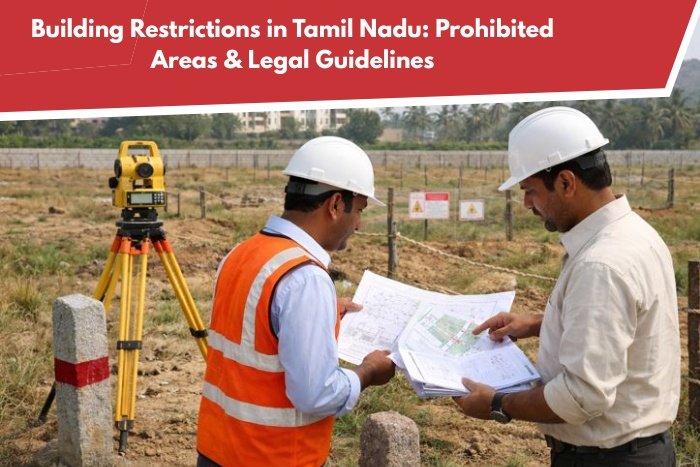
Development prohibited or restricted areas in Tamil Nadu are legally notified zones where authorities either prohibit construction or allow it only under strict conditions.
Before purchasing land or starting construction, it is essential to verify whether the property falls under development prohibited or restricted areas in Tamil Nadu as per applicable planning regulations.
Why Understanding Development Restrictions Matters in Tamil Nadu
When you plan any building or layout development in Tamil Nadu, it’s not enough to just look at FSI, road width and setbacks. There are certain prohibited and restricted zones where development is either fully banned or tightly controlled.
This guide summarises the key restrictions taken from the Tamil Nadu Government Gazette, so that land buyers, builders, architects and promoters can make informed decisions before investing or applying for approvals.
1.Development Prohibited or Restricted Areas in Tamil Nadu – Proximity to Quarries and Crushers
1.1 Distance from Live Quarries
- Planning authorities do not permit subdivision, layout approval, or construction of any residential, commercial, industrial, institutional, or habitable structure within 300 metres of an existing live quarry.
If a quarry is claimed to be abandoned, a certificate from the local body or licensing authority is required to prove that it is indeed not in operation.
1.2 Distance from Crushers
- Authorities prohibit the construction of residential, commercial, or institutional buildings within a 500-metre radius of an existing crusher.
1.3 Setting Up New Crushers
- No crusher is allowed within 500 metres from an existing residential area.
What it means for you:
- Always check for live quarries and crushers around your site.
- Distances from these units can directly affect building permission and layout approval.
2. Minimum Clearances from Power Lines, Tracks & Other Utilities
The following minimum distance requirements apply for safety and service clearances:
2.1 Low Tension (LT) Power Lines and High Tension (HT) Power Lines
From portions of building accessible to persons:
- Minimum horizontal clearance: 1.75 m
- Minimum vertical clearance: 4.50 m
From portions of building inaccessible to persons:
- Minimum horizontal clearance: 1.25 m
- Minimum vertical clearance: 2.50 m
Note:-LT/HT lines can be shiftable – you may shift the line flow with the consent of TANGEDCO.
Generally, for High voltage HT lines, you may asked to provide 7.0m horizontal clear space for safety reasons.
For sites affected by LT/HT overhead lines or underground cables, construction is permitted only after obtaining a No Objection Certificate (NOC) from TANGEDCO.
2.2 Cremation and Burial Grounds
- Authorities do not permit construction within 30 metres of a cremation or burial ground where piped water supply is not available.
2.3 Electric / Gasified Crematorium
- For constructions around a crematorium site, no external NOC is required.
- However, the crematorium structure itself must maintain a minimum setback of 10 metres on all sides within its own site.
2.4 Railway Tracks
- Developers must maintain a minimum distance of 30 metres from the railway boundary for any construction.
- Constructions can be permitted closer only after obtaining clearance from the concerned Railway authority.
What it means for you:
If your site is near power lines, cremation grounds or railway tracks, you must check these minimum distances and get NOCs where required.
3.Areas Around Indian Air Force or Naval Air Stations
Government notifications prohibit development on lands located within 100 metres of the boundary of Indian Air Force or Naval Air stations.
This restriction is as per Government of India Notifications and is meant to safeguard national security and operational safety.
What it means for you:
If your site falls within 100 m from the boundary of an IAF or Naval air station, you cannot take up development there.
4. Areas Around Airports or Aerodromes
4.1 Height Restrictions Near Airports and Aerodromes
Any building or structure in the vicinity of civil or defence aerodromes must follow the regulations of the respective Civil Aviation or Defence authorities. The latest rules and amendments as notified by the Directorate General of Civil Aviation (DGCA) must be complied with in all such cases.
If your site is:
- Within 20 km from an aerodrome reference point, and If your proposed building height is 18.3 metres or more, AAI height clearance NOC is mandatory.
- In certain notified/critical areas, NOC is required even for buildings below 18.3 metres.
then you must obtain a No Objection Certificate (NOC) from DGCA.
4.2 Chennai Metropolitan Area Airport Funnel Zones
Within the Chennai Metropolitan Area (CMA), certain areas fall in:
- Approach funnels
- Transitional areas
- Trough around runways
These are regulated zones as shown in specific maps annexed by authorities.
What it means for you:
- Always check if your land is within 20 km of an airport.
- If your building goes above 18.3 m, DGCA NOC is mandatory.
- In CMA, special maps define additional restricted zones around runways.
4.3 Hill Stations (HACA Areas)
The following sensitive areas are regulated and may need special clearances:
Areas classified under HACA villages in Tamil Nadu require special attention and care for any type of development.
In hill stations especially, a No Objection Certificate (NOC) from the Architectural Aesthetic Aspects (AAA) Committee is required for building construction.The Architectural Aesthetic Aspects (AAA) Committee is a government-established body that regulates building design and construction to preserve the natural, ecological and scenic character of the area.
For large-scale developments in these regions, additional NOCs / clearances may also be required from departments such as:
- Forest Department
- Geology & Mining Department
- District Collectorate
- Agricultural Engineering Department
- Directorate of Town and Country Planning (DTCP)
These controls ensure that development is environmentally sensitive, visually harmonious, and compliant with hill area regulations.
4.4 Nuclear Stations and Sterilised Zones
Lands surrounding nuclear stations that is notified by the Ministry of Atomic Energy, Government of India as a “Sterilised Zone”.
4.5 Reserved Forests, Wildlife and Bird Sanctuary Areas
Areas in the vicinity of reserved forests, wildlife sanctuaries or bird sanctuaries. Development in these areas will be permitted only after considering the applicable Acts, Rules and notifications, and getting the required clearances.
What it means for you:
Development may be possible, but only after regulatory compliance with forest, environment, atomic energy, or hill station building rules.
5. Defence Establishments
For sites located within 500 metres from the boundary of defence areas or military establishments,
you must obtain prior clearance from the defence authority.
6. Oil / Gas Pipelines
If your site is near Oil or Gas pipelines, you must comply with:
- The minimum clearance distances, and
- Other stipulations laid down by the respective pipeline authority.
7. Solid Waste Dumping Yards
Authorities restrict all habitable uses within 30 metres of a solid waste dumping yard.
What it means for you:
Residential or other habitable buildings are restricted close to dump yards for health and environmental reasons.
8. Catchment Area (Only for CMA)
Within the Chennai Metropolitan Area (CMA):
- Redhills and Puzhal lakes are key water sources for Chennai city.
- To protect these water bodies from adverse development impacts, contiguous areas in their catchments have been declared as “Redhills catchment area”.
What it means for you:
If your land is in the Redhills / Puzhal catchment, expect stricter development controls to protect drinking water sources.
9. Pallikaranai Swamp Area (Only for CMA)
The Pallikaranai Swamp is an ecologically sensitive natural wetland and plays a critical role in the drainage and flood management of the surrounding region.
Because of its environmental importance, authorities have declared the contiguous Pallikaranai swamp area as a conservation zone and prohibit all development there.
What it means for you:
Lands in the notified Pallikaranai swamp conservation area cannot be developed for building purposes.
10. Construction of Religious Buildings
Planning authorities accept building applications for religious institutions only after the applicant submits a No Objection Certificate.
Religious institution means any:
- Temple
- Math
- Mosque
- Church
- Or any other place of worship
that is dedicated for public use as a place of religious worship.
What it means for you:
For any new temple, mosque, church, etc., Collector NOC is mandatory before planning permission.
11. Constructions Around ASI-Notified Monuments & Heritage
If your site falls in special zones like:
11.1 Monument Protection Zones
Areas around protected monuments (like temples, forts, churches, mosques, heritage structures) where construction and land use are strictly controlled. The aim is to protect the visual setting, historical value, and structural safety of the monument. Building height, design, and even land use near these zones are regulated so that new development does not disturb or dominate the monument.
11.2 Heritage Towns and Heritage Streets
Towns or cities notified for their historical, cultural, or architectural importance – for example, traditional streets, old markets, temples, palaces, or colonial buildings. In heritage towns, building design, façade, materials, signage, and even colours may be regulated to retain the old character and streetscape. Development is allowed, but it has to be sensitive and in harmony with the heritage identity of the town.
- Any other area notified by the Central or State Government for special protection or restriction.
then, in addition to the normal planning rules, you must also follow:
- Special regulations / rules / guidelines issued by Central or State Government, and
- Obtain any necessary clearances / permissions from the concerned authorities.
What it means for you:
For heritage or notified areas, normal building rules are not sufficient.
12. Areas Around Windmills (Development Restriction)
Before commencing any development activity, the surrounding safety distance of the windmill shall be considered.
For example:
- Windmill tower height: 140 metres
- Rotor (wing) diameter: 120 metres
- Rotor radius: 120 ÷ 2 = 60 metres
- Safety clearance: 5 metres
Based on the above parameters, a minimum safety radius of 205 metres is to be maintained around the windmill.
Accordingly, no construction or development activity of any nature is permitted within a 205-metre radius from the centre of the windmill, in all directions.
All residential, commercial, industrial, or layout developments shall commence only beyond the 205-metre safety radius.
What it means for you:
If your land is near a windmill, ensure a minimum 205 m buffer before planning construction, failing which approvals may be rejected.
Conclusion
Before buying land or planning a building in Tamil Nadu, don’t check only FSI, road width and setbacks.
Always verify if your site falls in any prohibited or restricted zone (quarry, heritage/monument, airport, hill, forest, defence, dump yard, special CMA zones, etc.).
Skipping this can lead to approval rejection, legal issues and money loss.
Do proper due diligence and consult qualified professionals to ensure your project is safe, legal and future-proof.
Understanding development prohibited or restricted areas in Tamil Nadu helps avoid legal violations, approval rejections, and future demolition risks.